
Sowing Change, Saving Water: How Bhushankar a Farmer in Budaun Transformed Paddy Cultivation Through Direct Seeded Rice
In the water-stressed district of Budaun, Uttar Pradesh, farming has become increasingly challenging due to declining groundwater levels, rising cultivation costs, labour shortages, and the growing i
In the water-stressed district of Budaun, Uttar Pradesh, farming has become increasingly challenging due to declining groundwater levels, rising cultivation costs, labour shortages, and the growing impacts of climate change.
For decades, farmers in the region have relied on Traditional Puddled-Transplanted Rice (TPR) cultivation, a method deeply rooted in local agricultural practices but one that demands significant amounts of water and labour.
As these challenges intensified, many farmers began searching for more sustainable and efficient alternatives that could secure their livelihoods while conserving natural resources.
One such farmer is Mr. Bhushankar, a 65-year-old farmer from Agras village in Islamnagar Block, Budaun. Like generations before him, he cultivated paddy using traditional methods and depended heavily on continuous field flooding and manual transplanting.
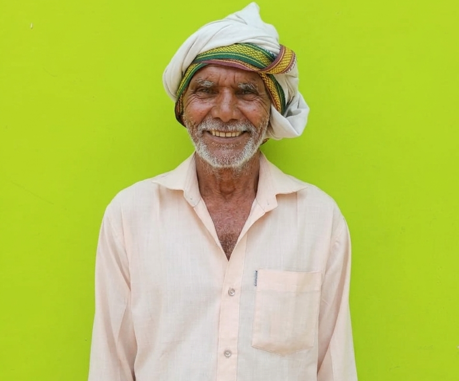
However, every cropping season brought new concerns. Groundwater levels were falling rapidly, labour was becoming increasingly difficult and expensive to access during the transplanting season, and cultivation costs continued to rise without corresponding increases in productivity.
Maintaining waterlogged fields required substantial investment and effort, while climate unpredictability added further uncertainty to agricultural operations. Although Mr. Bhushankar was committed to farming, he recognised that continuing with conventional practices would become increasingly difficult in the future.
He knew that a change is needed.
The Intervention
Through Project PRAWAH by HUF and implemented by SUVIDHA, Mr. Bhushankar was identified during a field-level assessment as a farmer who was willing to explore new agricultural practices.
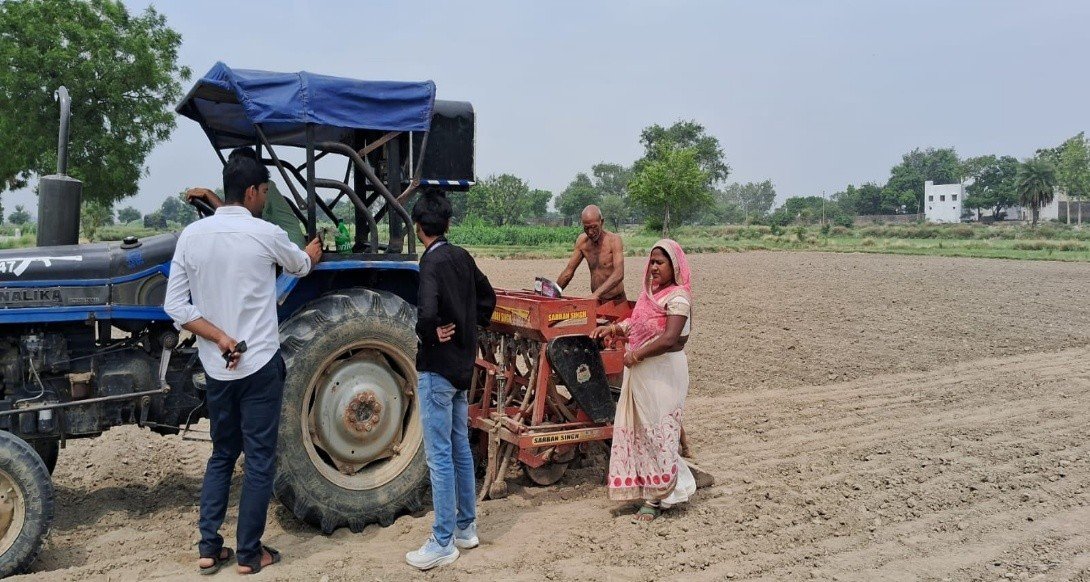
The project, which focuses on improving water security and promoting climate-resilient agriculture in some of Budaun’s most water-stressed blocks, introduced him to Direct Seeded Rice (DSR), an innovative cultivation technique that eliminates the need for nursery raising and manual transplanting while significantly reducing water consumption.
Guidance Throughout the Journey
To support his transition, the project team provided comprehensive training and technical guidance. Mr. Bhushankar participated in orientation sessions where he learned about the benefits of DSR compared to traditional paddy cultivation.
He received practical training on seed selection, field preparation, mechanised row sowing, and the importance of timely weed management. Demonstration plots were established to allow farmers to observe the differences between traditional and direct-seeded cultivation methods under real field conditions.
The project also facilitated access to mechanisation services and provided continuous handholding support throughout the crop cycle.
Encouraged by the guidance he received, Mr. Bhushankar decided to convert a portion of his paddy land from Traditional Puddled-Transplanted Rice to Direct Seeded Rice during the Kharif season. The results exceeded expectations. By eliminating nursery preparation and manual transplanting, he significantly reduced labour requirements and saved valuable time at the beginning of the cropping season.
Irrigation practices were also optimised, with water applied only at critical growth stages rather than maintaining continuous flooding. As a result, water consumption was reduced by approximately 20–25 percent.
The productivity gains were equally encouraging. While his traditional paddy fields produced around 3 quintals per bigha, the DSR plot yielded approximately 3.2 quintals per bigha, reflecting an increase of nearly 6.5 to 8 percent. In addition to higher yields, Mr. Bhushankar reported savings of nearly 15–25 percent in input costs and irrigation expenses.
The absence of transplanting shock further contributed to healthier crop establishment and improved overall crop performance.
The Impact
Beyond these measurable outcomes, the intervention brought about a significant shift in Mr. Bhushankar’s confidence and approach to farming. He became less dependent on seasonal labour and more capable of managing cultivation activities independently. The reduced physical effort required for sowing and the efficient use of resources made farming more manageable and economically viable.
Most importantly, he witnessed firsthand that adopting climate-resilient agricultural practices could improve productivity while conserving precious natural resources.
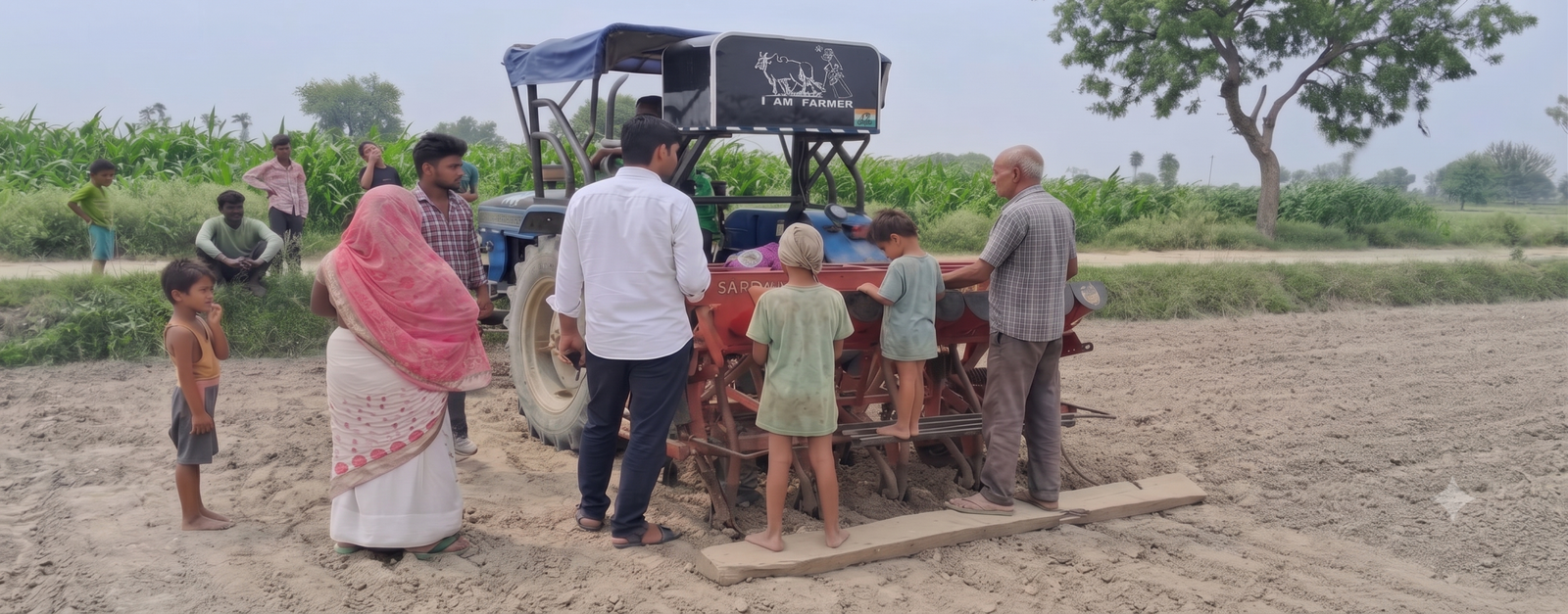
Today, Mr. Bhushankar’s farm serves as a demonstration site for neighbouring farmers who are interested in learning about Direct Seeded Rice. His experience has become a powerful example of how practical innovation, when supported by technical guidance and institutional backing, can encourage farmers to move beyond traditional practices and embrace more sustainable approaches.
The success of his DSR plot has generated interest among other farmers in the region, creating opportunities for peer-to-peer learning and wider adoption of water-efficient cultivation techniques.
Mr. Bhushankar’s journey is a testament to the transformative potential of climate-resilient agriculture.
Through Project PRAWAH, he was able to overcome longstanding challenges related to water scarcity, labour dependency, and rising cultivation costs while achieving improved productivity and profitability.
His story illustrates how targeted interventions, combined with farmer willingness and community-based support systems, can drive meaningful change at both the household and landscape levels.
As Project PRAWAH continues to promote Direct Seeded Rice across Budaun’s water-stressed blocks, stories like his offer a glimpse into a more sustainable and resilient future for agriculture.
Related Blogs
Smt. Thapi Devi resides in a village Sundungra located in Uttarakhand, India. She is an abandoned woman. Smt. Thapi Devi has a mentally challenged daughter. She used to work as a daily wage and made
In today's rapidly changing world, the term "carbon footprint" has become a buzzword, and for good reason. The carbon footprint of an individual, organization or even a product reflects the total amo
Teachers truly are the backbone of society. They are role models to children; they offer guidance and dedication to young minds. As mentors, they can form students into future leaders who then form t
In the quiet village of Samraj in Khargone district, Madhya Pradesh, life revolved around the rhythms of agriculture for Rekha Patel and her family. At 35, Rekha shared a modest home with her husband
In rural India, countless individuals possess the skills, determination, and ambition to improve their lives. Yet, many remain unable to move beyond subsistence livelihoods due to limited access to r